Authored by: Bryan Lachapelle, President & CEO
Authored by: Ashley Barron, Sales & Marketing Manager
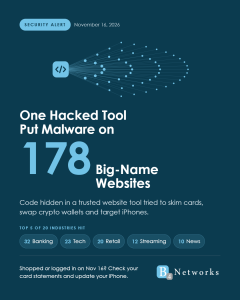 On November 16, 2026, visitors to the websites of 178 organizations, including Zoom, the BBC, CNN, IKEA and HSBC, were served malicious code. None of these companies had their own systems broken into. The code came through Optimizely, a tool they all use to test changes on their websites.
What Happened
Optimizely lets a business load a small piece of code, called a snippet, from Optimizely's servers onto its website. That snippet runs in each visitor's browser so the company can test different layouts and measure what works. It's a common, useful tool, which is exactly why so many big brands rely on it.
An attacker found a weakness in Optimizely's platform and used it to add their own code to customer projects, in an optional spot meant for a company's custom code that runs on every page. Because the code came from Optimizely's own servers, the websites loading it had no reason to treat it as suspicious. Optimizely has confirmed the incident and says the flaw has been fixed and the code removed.
This is what's called a supply chain attack. Instead of breaking into each website one at a time, the attacker went after a service all of those websites already trusted.
According to Report URI, the security firm that uncovered the attack, the first tampered code appeared around 11:20 p.m. Eastern on November 15. Most affected sites were clean by early evening on November 16, so the code was live for roughly 18 hours.
What the Code Was Built to Do
The code had three goals. First, it swapped crypto wallet addresses so that payments meant for someone else went to the attacker instead. Report URI counted about $7,000 in the attacker's wallets within the first nine hours. Second, it tried to capture credit card details typed into checkout pages. Report URI can't tell how many card numbers were exposed. Third, on iPhones and iPads, it tried to load an exploit, which is code designed to take over a device through a security flaw. So far, there are no reports of iPhones actually being taken over.
The card and crypto parts ran inside the web page itself, so they could have affected visitors on any device, including Android phones and computers.
Who Was Affected
Report URI found the code on sites across a wide range of industries.
| Sector | Orgs | Examples |
|---|---|---|
| Banking & Finance | 32 | Paychex, HSBC US, Equifax, SmartAsset, HSBC Hong Kong |
| Technology & SaaS | 23 | Zoom, Bitly, Salesforce, GitLab, Optimizely |
| Retail & Fashion | 20 | IKEA, ASOS, Mattel, American Eagle, Scheels |
| Streaming & Entertainment | 12 | Peacock, D&D Beyond, Wizards of the Coast, NOW TV, Zattoo |
| News & Media | 10 | CNN, BBC, Fox News, NPR, CTV News |
| Airlines & Travel | 9 | Alaska Airlines / Hawaiian Airlines, Transavia, Air France-KLM, KLM Netherlands, Trafalgar |
| Healthcare & Pharma | 8 | Invisalign, Takeda, Covetrus, iTero (Align), Covetrus Pharmacy |
| Industrial & Manufacturing | 8 | Fluke, eMaint (Fluke), Fluke Networks, Vaillant Germany, Fluke Process Instruments |
| Telecoms | 7 | Virgin Media, Virgin Media O2, Vodafone Australia, O2, TPG Telecom |
| Crypto & Trading | 6 | Ledger, IG, OANDA / Coinpass, interactive investor, TMS Brokers |
| Insurance | 6 | Asurion / uBreakiFix, Mutual of Omaha, Admiral, Securian Financial, eRenterPlan |
| Property & Real Estate | 6 | Buildium (managebuilding.com), Loft Living apartments, HireAHelper, Flytte.no (and sister comparison sites) |
| Food & Hospitality | 5 | Restaurant ordering sites (order.online), Heineken, Home Chef, Starbucks Canada, Cinnabon |
| Home & Smart Home | 5 | Resideo, Honeywell Home, myQ (Chamberlain), Chamberlain, First Alert |
| Nonprofit & Civic | 4 | Change.org, ASPCA, UNICEF USA, DonorsChoose |
| Gambling | 4 | Betsson, PokerStars, tombola, Betfred |
| Professional Services | 4 | Freshfields, CohnReznick, Baringa, Cro Metrics |
| Logistics & Shipping | 3 | ShipStation / ShipEngine, Stamps.com, ShipEngine |
| Automotive | 3 | Lucid Motors, O'Brien Glass, Chevrolet dealer network (Bill Rapp and others) |
| Education | 3 | Walden University, Perlego, Chamberlain University |
What You Should Do
If you visited, shopped on or logged into any of these sites between late on November 15 and early evening on November 16, we recommend taking a few minutes to do the following:
- Check your credit card statements for charges you didn't make, and report anything unfamiliar to your bank right away. If you paid for something on one of these sites that day, it's reasonable to ask your bank about a replacement card.
- If you sent crypto that day, double-check the wallet address the funds went to.
- Update your iPhone or iPad to the latest version of iOS.
- As a precaution, change your password on any affected site you use, and turn on multi-factor authentication (a second step, like a code sent to your phone) where it's offered.
What This Means for Businesses
Outside tools like Optimizely, chat widgets and analytics are a normal part of running a modern website, and there are good reasons to use them. The catch is that every one of them can run code on your site, so your website is only as trustworthy as the tools it loads. In this case, the companies' own systems were never breached, yet their visitors were still put at risk.
It's worth knowing which outside tools your website relies on, and making sure someone keeps an eye on them. If you're a B4 client and have questions about this, or need a hand, reach out to our team. Not a client yet? We'd be happy to chat.
Sources
- Report URI: World's Largest Brands Infected With Malware Via Optimizely (original research and full list of affected sites)
- SecurityWeek: Optimizely Vulnerability Exploited to Serve Malware on Major Websites
- The Hacker News: Hijacked Optimizely Scripts Served Card Skimmer and iOS Exploit Kits
- Help Net Security: Malware Spread Through Optimizely Hits 178 Organizations